
[How to] Write badge certificate
War badges and certificates
For the German soldier in the Wehrmacht, badges and decorations were more than just decorations worn on the uniform. They represented military achievements, combat experience, specialized qualifications, wounds sustained in action, or acts of bravery. Before a decoration could be awarded, a soldier had to either meet the prescribed requirements for the badge or be formally recommended for the decoration by his superiors. The decoration could only be officially awarded after approval by the military command.
Each officially awarded badge was usually accompanied by a certificate of decoration. This document served as official proof of the award. The certificate was as important as the badge itself, as it provided documentary evidence of the soldier's entitlement to wear the decoration and supported the entries in the military records in the Wehrpass and Soldbuch.
Certificates were usually prepared by the unit office, where clerks entered the soldier's personal details (rank, name, and unit) either by typewriter or by hand. Once completed, the document was sent for signature to the officer authorized to award the decoration. Although the commander's signature appeared on the certificate, the actual administrative work was performed by office staff.
Process of Awarding Decorations
The process varied depending on the type of decoration. Qualification badges, such as marksmanship awards or specialty badges, were generally issued after the soldier had met clearly defined requirements. Combat decorations, on the other hand, required a formal recommendation from commanders and subsequent approval by the appropriate headquarters.
Due to the shortage of supplies during the war, actual physical badges were often not available. In such cases, the soldier received only a certificate and an entry in his Soldbuch, which was sufficient to wear the appropriate ribbon or the option to purchase a second or replacement piece from private manufacturers.
Paperwork and Presentation
Unlike the badge, which was intended to be worn, the certificate was intended to be kept. Soldiers kept their decorations with other important military documents and often sent them home to civilian relatives for safekeeping to prevent them from being destroyed in combat.
Badges were commonly issued in simple paper envelopes or, in the case of higher ranks, in presentation cases. These envelopes were practical rather than decorative, usually made of cheap recycled paper towards the end of the war, and bore basic markings identifying the decoration and the manufacturer. Since soldiers usually pinned the badge to their uniform and threw away the packaging, surviving original envelopes are considerably less common today than the decorations themselves. This is especially true for badges that were actually issued and worn during the war.
Conclusion
For collectors, historians, and reenactors, certificates and envelopes provide valuable context that connects the decoration to the administrative realities of war service. Together, they illustrate not only the award itself, but also the process by which it was officially awarded and recorded.
Guide: How to fill award certificates
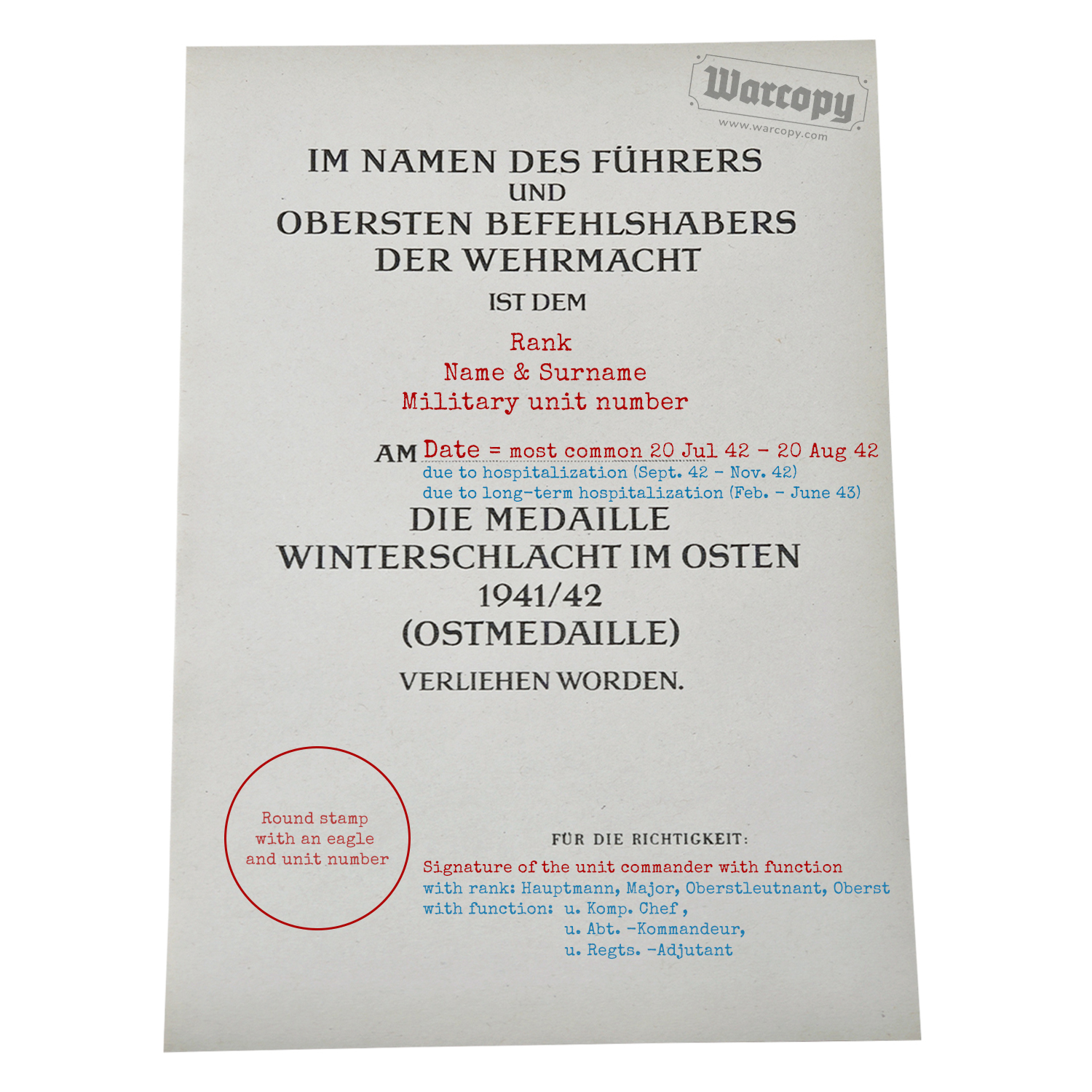
Ostmedaille 1941/42
- Rank: Use standard German abbreviations (e.g.,
Gefr.,Obgefr.,Uffz.,Hauptmann). - Name & Surname: First name and last name. Space out the surname letters for an authentic look (e.g., S c h m i t t).
- Military Unit (Required): Explicitly type the soldier's company or regiment right under the name (e.g.,
5./Art.-Regt.7). - Date:
- 20. July 1942 – 20. August 1942 (Most common, standard issue)
- September 42 – November 42 (Due to standard hospitalization delay)
- February 43 – June 43 (Due to long-term hospital recovery)
- Stamp & Signature (Rule of Triple Consistency): The unit on the round stamp, the officer's signature, and the typed function underneath must match perfectly:
- Company stamp -> type
u. Komp. Chef(Captain/Major signature) - Battalion stamp -> type
u. Abt.-Kommandeur(Captain/Major signature) - Regiment stamp -> type
u. Regts.-Adjutant(Lieutenant/Captain signature)
- Company stamp -> type
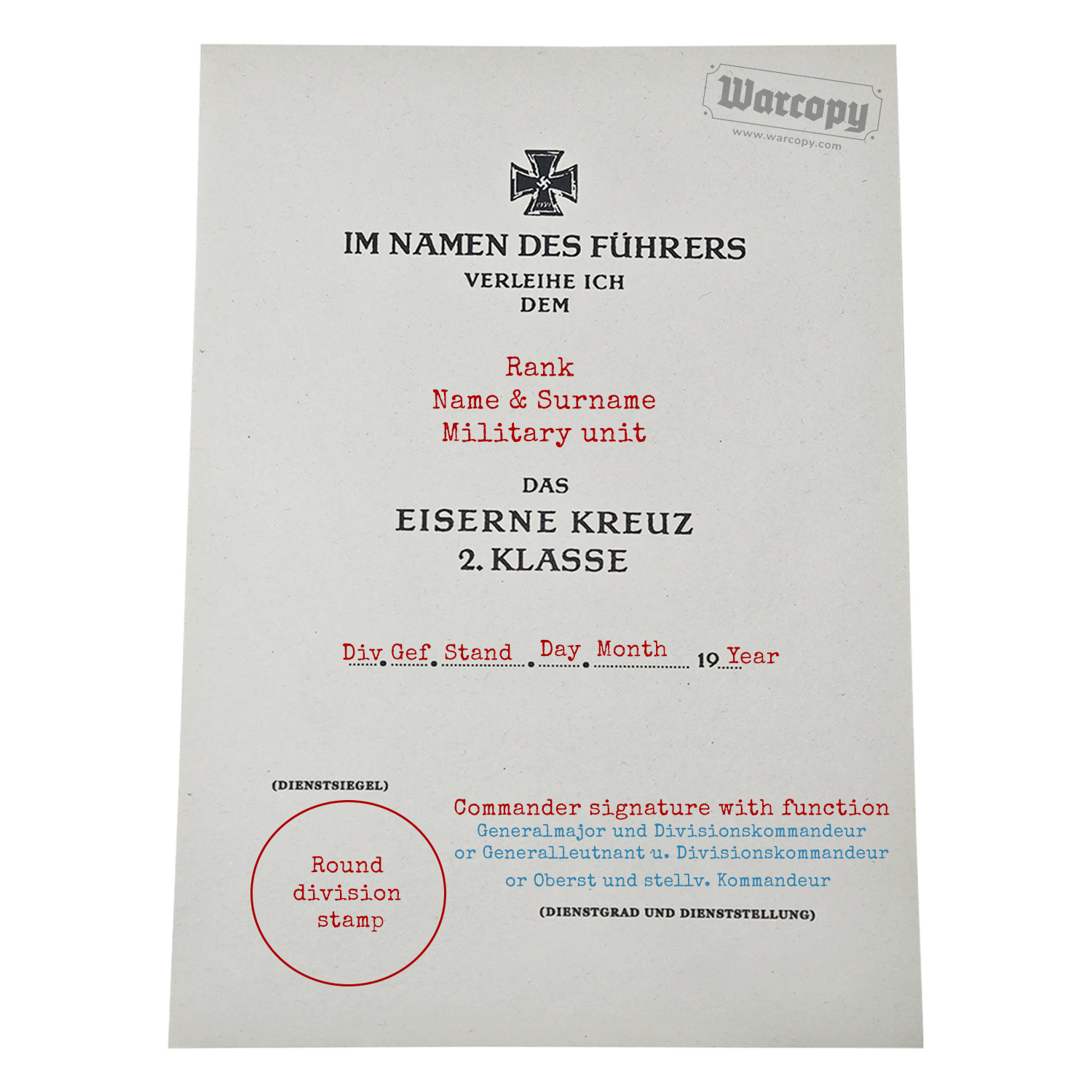
Iron cross 2. class
- Rank: Enter the soldier's rank. You can type it as a full word in the German dative case (e.g.,
Gefreiten,Unteroffizier) or use standard abbreviations (e.g.,OGefr.,Lt.). - Name & Surname: Type the first name followed by the surname. Space out the letters of the surname for an authentic wartime typewriter look (e.g.,
K r e i s c h). - Military Unit Number: Explicitly type the soldier's specific unit directly below the name line (e.g.,
4. / Gren.- Rgt. 544). - Location & Date Line: On the dotted line, type
Div.Gef.Std.orDiv.Gef.Stand(Division Combat Post). For the date, choose any historically logical front-line date between September 1939 and May 1945. - Stamp & Signature (The Divisional Rule): Because this high-level award was issued by a Division Headquarters, the round stamp and the commander's signature function must match identically:
- Standard General Option: Use a round stamp of an Infantry or Panzer Division -> signed by a
GeneralmajororGeneralleutnant-> type the function underneath asGeneralmajor und DivisionskommandeurorGeneralleutnant u. Divisionskommandeur. - Acting Colonel Option: If the division was temporarily commanded by a Colonel (
Oberst), type the function asOberst und stellv. Kommandeur(Colonel and Acting Commander).
- Standard General Option: Use a round stamp of an Infantry or Panzer Division -> signed by a
Historical Note for Researchers: While the example picture covers the standard combat field variant (90% of surviving documents), certificates issued to wounded soldiers recovering back home in Germany will feature a specific city name (e.g., DRESDEN), a Military District stamp (Wehrkreis), and the signature of a district commander (Befehlshaber im Wehrkreis).
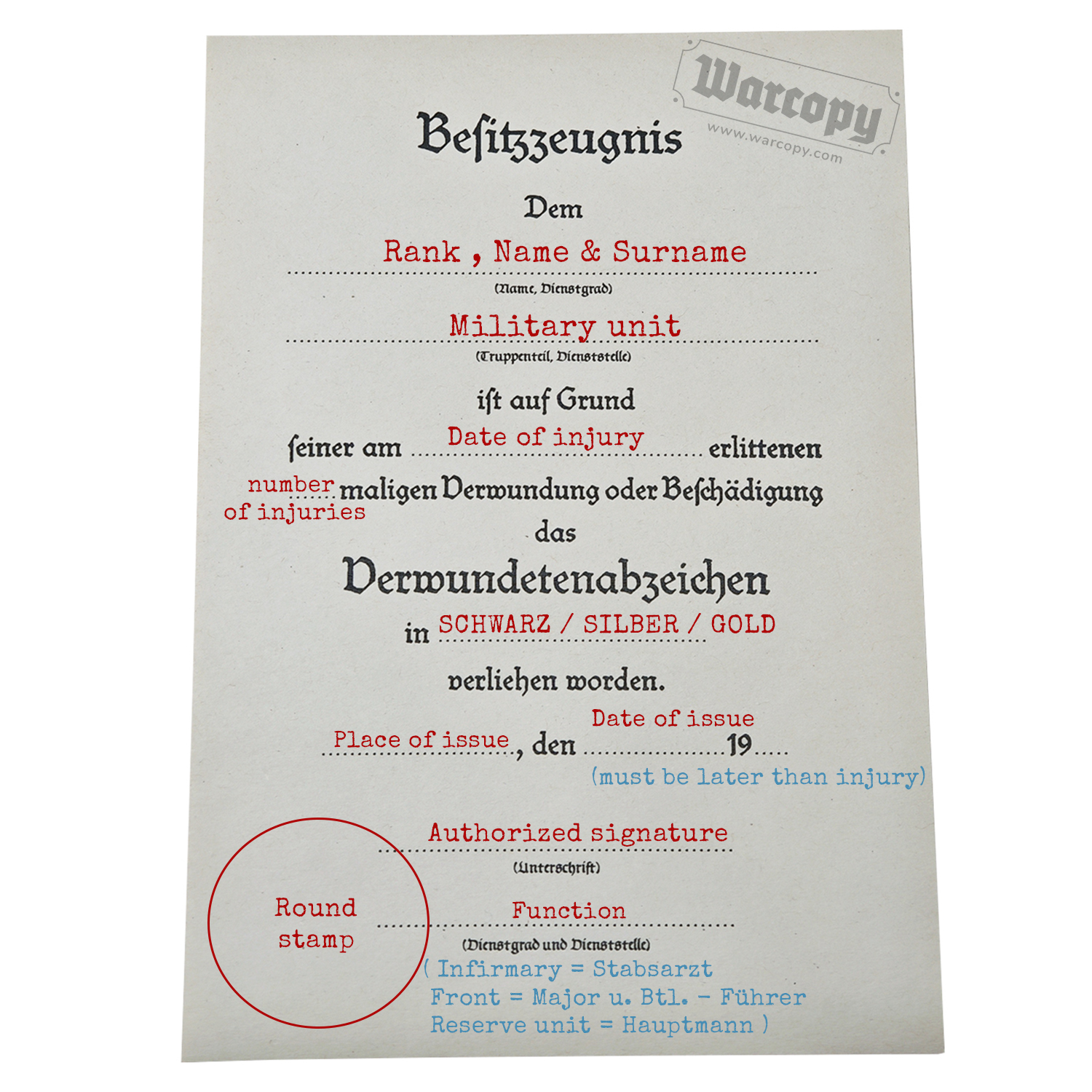
Wound badge
- Rank, Name & Surname: Enter the rank (in German dative) + first name + surname with spacing between letters (e.g.,
Gefreiten Rudolf B e r n h a r d t). - Military Unit: Mandatory field. Enter the official active front-line or domestic reserve unit abbreviation (e.g.,
7./Geb.Jg.Rgt.218). - Date of Injury: The exact date the soldier was wounded. If the certificate is for multiple wounds, list all dates chronologically separated by commas (e.g.,
16.9.41, 9.8.43, 1.2.44). - Number & Class: Write the total number of wounds to justify the badge class:
1or2wounds -> SCHWARZ (Black).3or4wounds -> SILBER (Silver). Note: Silber can also be awarded for a single (1) severe wound, such as the loss of a limb or hearing.5or more wounds -> GOLD (Gold).
- Place & Date of Issue: The location and date when the document was signed. Crucial rule: The date of issue must always be later than the injury date.
- Stamp & Function (Align with ONE scenario):
- Infirmary: City name (e.g.,
Rudolstadt) + Hospital stamp + Signed by doctor with functionStabsarztorOberstabsarzt. - Front Line: Combat post (e.g.,
Btl.-Gef.-Std.) + Battalion stamp + Signed by commander with functionMajor u. Btl.-Führer. - Reserve Unit: Garrison town (e.g.,
Paderborn) + Replacement unit stamp + Signed by officer with functionHauptmann.
- Infirmary: City name (e.g.,
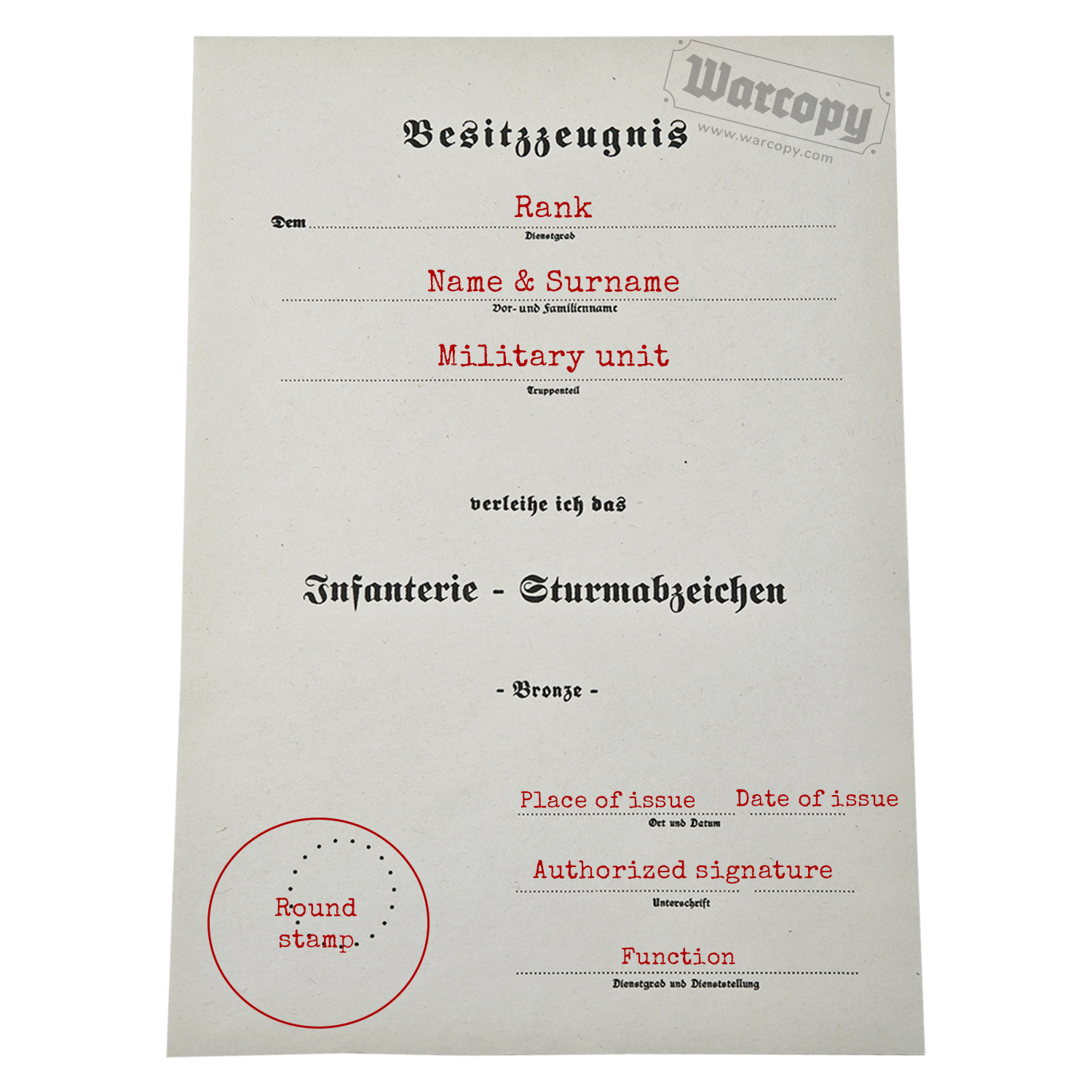
Bronze Infanterie - Sturmabzeichen
- Rank & Name: Enter the soldier's rank (in German dative case, e.g.,
GefreitenorUnteroffizier) on the first line. Type the first name and surname with spaces between the letters on the second line (e.g.,Carl G e b h a r d t). - Military Unit: Mandatory field. Enter the official front-line combat regiment or battalion abbreviation (e.g.,
3.Komp./Infanterie-Regiment 90or5./Sich.Regt.602). - The "Date of Injury" Line: Leave this area completely blank! Infantry Assault Badges were awarded for combat engagements, not wounds. Do not type any dates in the middle of the certificate.
- Badge Class (Silber vs. Bronze): Make sure the printed or typed class matches the unit type:
- Silber (Silver): For standard infantry, motorized infantry, and anti-tank units.
- Bronze (Bronze): For Panzergrenadier units, machine-gun/support companies, and motorized reconnaissance.
- Place & Date of Issue: Enter the headquarters type and date (e.g.,
Rgt. Gef. Stand, den 31.3.42orK.Gef.Std., 22.Mai 43). - Stamp & Function (Align with ONE authorized scenario):
- Regiment Level: Place of issue =
Rgt. Gef. Stand. Round stamp = Regiment stamp. Function = Typed asOberst u. Regiments-Kommandeur. - Corps / Division Level: Place of issue =
K.Gef.Std.orK.H.Qu.. Round stamp = Large Corps Headquarters stamp (Generalkommando). Function = Typed asGeneral der Infanterie und Kommandierender General.
- Regiment Level: Place of issue =